
undefined 30, 2025

Microsoft launches ‘vibe working’ in Excel and Word
Microsoft is bringing “vibe working” to Office with Agent Mode in Excel and Word and a new Office Agent in Copilot chat. Powered by GPT-5 and Anthropic models, these tools can create spreadsheets, documents, and presentations from prompts, breaking complex tasks into transparent steps. Excel’s Agent Mode improves accessibility with 57.2% benchmark accuracy, while Word offers interactive drafting. Office Agent extends to chat, generating PowerPoint decks with research and previews.

OpenAI adds parental controls to ChatGPT for teen safety
OpenAI is adding parental controls to ChatGPT to give teens a safer, age-appropriate experience amid concerns over AI harms. Parents and teens link accounts to enable protections like filters for graphic or sexual content, quiet hours, and controls over memory, images, and voice. Teens can unlink anytime, with parent alerts. A new system also notifies parents if a teen shows signs of distress. OpenAI stresses the safeguards aren’t foolproof but aim to promote healthy AI use.

Cyber attacks: '80%' of ransomware victims pay up
A Hiscox report shows 80% of firms hit by ransomware in the past year paid up, yet only 60% recovered data and nearly a third faced further demands. Of 5,750 SMEs surveyed, 27% suffered ransomware attacks, with almost 60% reporting some cyber incident. High-profile cases like JLR, M&S, and the Co-op highlight risks, with damages reaching hundreds of millions. Hiscox warns cyberattacks threaten business survival, pushing growth in costly cyber insurance despite gaps in data protection.

YouTube agrees to pay $24.5M to settle Trump lawsuit filed after account suspension
YouTube will pay $24.5M to settle Donald Trump’s lawsuit over his suspension after Jan. 6, with $22M going to his White House ballroom fund and $2.5M to co-plaintiffs. The deal makes Google the last Big Tech firm to settle, after Meta and X earlier paid $25M and $10M. Paramount and ABC also settled separate suits. Though courts doubted Trump’s claims, tech companies opted to pay, with total settlements topping $80M as industry leaders seek favor with his new administration.

OpenAI new social network is reportedly TikTok if it was just an AI slop feed
OpenAI is reportedly planning a standalone Sora 2 app with a TikTok-style feed of entirely AI-generated videos. Users could scroll, like, comment, and remix clips up to 10 seconds long, but not upload real footage. Wired says identity verification via facial recognition may allow users’ likenesses to appear in others’ videos, raising deepfake concerns. OpenAI promises filters against explicit or copyrighted content, though past safeguards have proven imperfect.

Source: interestingengineering
240 million-year-old monster marine reptile’s fossil discovered with intact skin
Scientists discovered a rare Lariosaurus valceresii fossil with preserved skin in Switzerland’s Monte San Giorgio, dating back 240M years. The near-complete specimen shows webbed hands and feet, carbon-film scales, and strong forelimb muscles, revealing it swam with a seal-like “rowing-flying” motion rather than relying on its tail. The find, the first of its kind for this species, offers new insight into early marine reptile anatomy and swimming strategies after the Permian extinction.
Why a solution to AI hallucinations would kill ChatGPT tomorrow
OpenAI’s latest paper explains why AI “hallucinations” are inevitable: language models predict words step by step, so errors accumulate, and even perfect training data can’t prevent them. Benchmarks worsen the issue by penalizing “I don’t know,” pushing AIs to always guess. OpenAI proposes confidence-based scoring to cut errors, but this would raise costs and frustrate users with frequent uncertainty. For now, business incentives favor fast, confident, but error-prone, answers.

Which countries in Europe have spotted suspicious drones in their airspace?
At least 10 European nations, including Lithuania, Poland, Romania, Denmark, Norway, France, Germany, and Latvia, have reported mysterious drone incursions in recent months. Some carried explosives, disrupted airports, or targeted military bases. Denmark even banned civilian drone flights during an EU summit. NATO has boosted vigilance, and the EU is building a “drone wall” on its eastern border. Many incidents are linked to Russia, though investigations continue.
Scientists discover new dinosaur in Argentina with crocodile bone in mouth
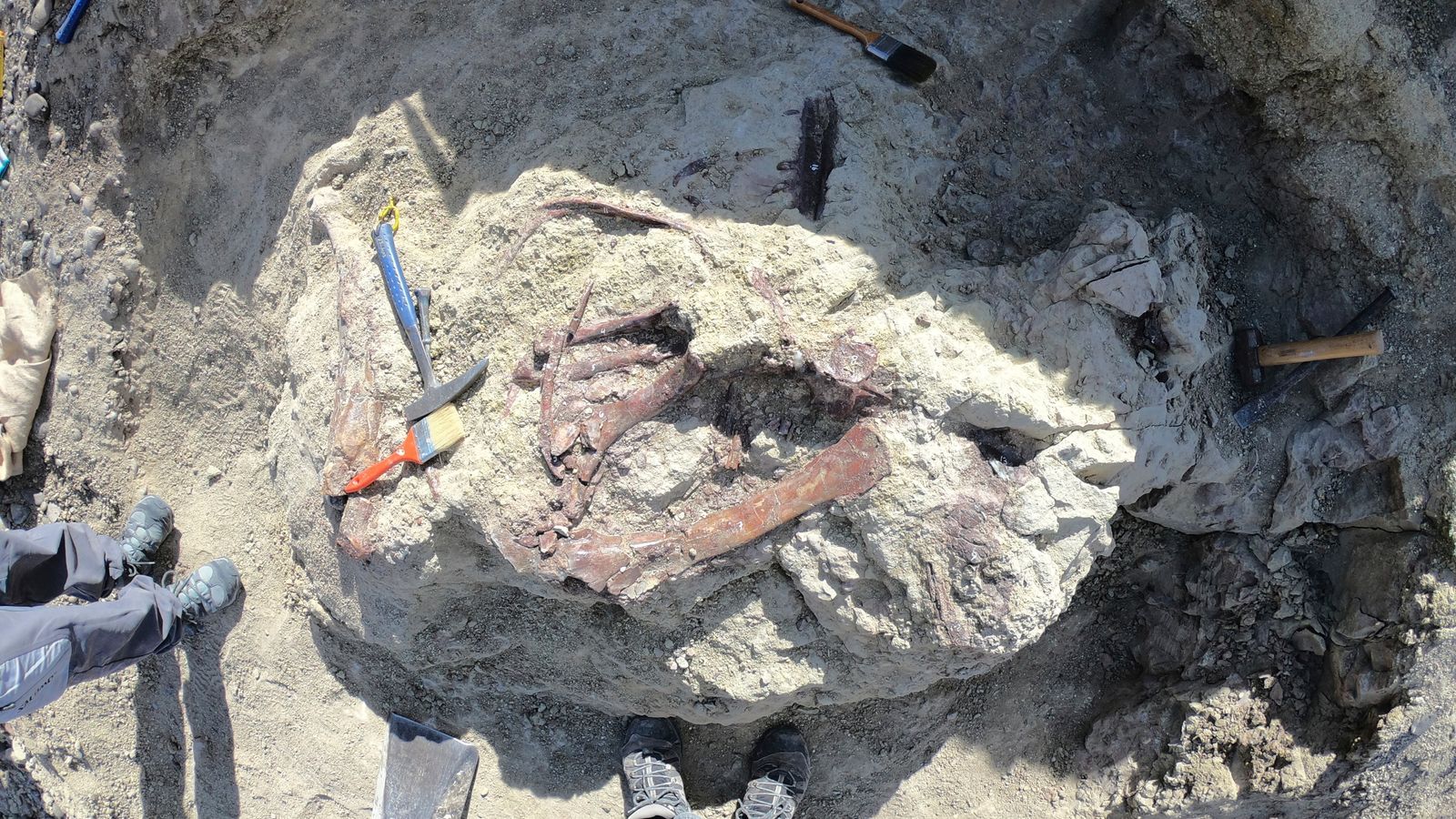
Scientists in Argentina discovered a new megaraptoran dinosaur, Joaquinraptor casali, from 66–70M years ago. Found in Patagonia’s Lago Colhue Huapi formation, the 23-ft predator died at about 19 years old. Its remains include skull, limb, and tail bones, plus a crocodile relative’s bone pressed to its jaw, hinting at its diet. Known for long skulls and massive claws, megaraptorans roamed South America, Australia, and Asia. The find is one of the most complete skeletons yet.

Source: interestingengineering
GPT-5 model helps crack one of quantum computing’s most stubborn open problems
Researchers used GPT-5 to help prove strict limits in quantum complexity theory’s QMA class. In QMA, proofs come as quantum states verified by algorithms. Amplification methods improve accuracy, but it was unknown if completeness could surpass doubly exponential closeness to 1. GPT-5 suggested reframing with a key function, enabling a proof that completeness can’t exceed doubly exponential and soundness can’t drop below exponential. The result sets hard limits and marks a rare AI-aided breakthrough in quantum theory.